

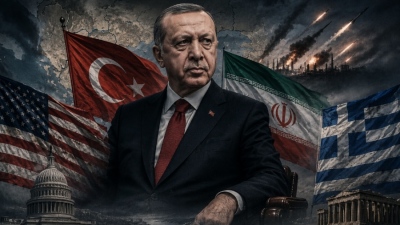
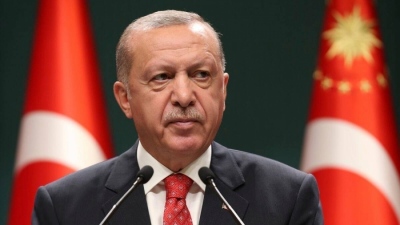
At the time when the United States and Israel are involved in a costly and dangerous confrontation with Iran, another regional player seems to exploit the conflict to his benefit without having fired a single shot. According to an analysis by the Telegraph, the real geopolitical winner of the crisis may be Recep Tayyip Erdogan and Turkey, which appears to strengthen both its regional and international influence simultaneously.
The West looks at Iran and Erdogan consolidates his power
As global attention remains focused on developments around Iran, the Erdogan government seems to acquire a greater margin of maneuver inside the country. The Telegraph argues that the international focus on the war has limited the reactions against domestic political developments in Turkey, allowing the Turkish leadership to strengthen its control against the opposition without a serious international cost. For Erdogan, the regional turmoil acts as a political shield. As long as the United States, Europe, and NATO focus on the Iranian crisis, the pressure toward Ankara regarding issues of democracy and human rights passes into the background.
Turkey transforms into an irreplaceable player
At the same time, Turkey appears to strengthen its diplomatic value. Ankara has maintained open channels both with Tehran and with the West, presenting itself as one of the few countries that can talk with all sides. Erdogan himself has repeatedly argued that the crisis can be solved only through negotiations and not through military escalation. This stance allows Turkey to appear as a potential mediator, increasing its geopolitical weight in a period where most regional powers have sided openly in favor of the one or the other side.

American attrition creates a strategic vacuum
One more element that strengthens the position of Ankara is the attrition of American influence in the Middle East. The long-term military involvement of the United States, the consumption of huge quantities of missile systems, and the growing uncertainty around the strategy of Washington create a geopolitical vacuum that regional powers try to fill. Turkey appears determined to exploit this conjuncture. Analysts estimate that Ankara attempts to strengthen its role in the Caucasus, Iraq, Syria, the Eastern Mediterranean, and the Persian Gulf, presenting itself as an independent pole of power between the West, Russia, and Iran.
Erdogan wins without fighting
The paradox of the current crisis is that Turkey does not participate directly in the war but may derive significant geopolitical benefits from it. While Israel and the United States shoulder the military and economic cost of the conflict and Iran tries to maintain its deterrent power, Ankara exploits the conjuncture to strengthen its negotiating position, expand its regional influence, and upgrade its role in international developments. This is also the reason why more and more analysts consider that the big winner of the conflict is located neither in Washington nor in Tehran, but in Ankara. And if the war continues or is prolonged, the Turkey of Recep Tayyip Erdogan may emerge from the crisis stronger than ever, transforming into one of the basic shapers of the new balance of power in the Middle East.

What the Turkish geopolitical gains mean for Greece
The geopolitical realignments caused by the conflict between the United States, Israel, and Iran do not affect only the Middle East. Greece, as a country of the Eastern Mediterranean and an important energy and shipping hub, finds itself faced with new challenges but also opportunities. First of all, every period of tension in the Straits of Hormuz directly affects international oil and natural gas prices. Given that the Greek economy remains dependent on energy imports, a prolonged crisis could increase energy costs for businesses and households. At the same time, the upgrade of Turkey as a regional power causes particular concern in Athens. If Ankara manages to exploit the strategic vacuum created by the absorption of American attention in the Middle East, it may acquire greater influence in issues regarding the Eastern Mediterranean, Syria, Libya, and the energy routes of the region. At the same time, Greece seeks to strengthen its position as a reliable partner of the European Union and the United States, promoting infrastructure projects, ports, and energy connections that can function as alternative gateways to Europe in a period of growing regional instability.
Intense anxiety in Athens over national issues
However, the greatest concern for Athens is that a Turkey emerging geopolitically strengthened from the crisis will possess greater self-confidence and more diplomatic footings in negotiations with the West. This could affect the balances in a series of issues of Greek interest, from the Aegean and the Eastern Mediterranean to the Cyprus issue. For Greece, therefore, the crisis does not constitute a distant event of the Middle East. It is a development that can directly affect the economy, energy security, and strategic environment of the country in the coming years.

www.bankingnews.gr


Σχόλια αναγνωστών